Trust & security
How AvenorOps handles your data
This page is maintained by AvenorOps to answer the questions IT and security teams usually ask during due diligence. It describes what is actually in place today — AvenorOps is an early-stage product in controlled beta, and where something is not yet formalised we say so rather than implying otherwise. It is informational, not a contractual document.
Data isolation between customers
AvenorOps is multi-tenant: every supplier, contract, document and activity record carries the identifier of the firm that owns it (firm_id). Isolation is enforced in two independent layers, so a mistake in one does not expose data:
- Database level. Postgres Row-Level Security policies are enabled on customer tables. The database itself refuses to return rows belonging to another firm, regardless of what the application asks for.
- Application level. Server-side permission checks (
assertFirmAdmin/assertGlobalAdmin, centralised in a single module) gate every administrative operation, and queries are scoped by firm before they reach the database.
In plain terms: the application does not simply trust itself to filter correctly. The database enforces the boundary as well.
Infrastructure & hosting
- Customer data (database, authentication records and uploaded documents) is stored in Supabase — managed PostgreSQL, Auth and object storage.
- The Supabase project runs on AWS in the ap-northeast-2 (Seoul) region. Data residency in New Zealand or Australia is not currently offered; if regional residency is a requirement for your firm, contact us before onboarding.
- The AvenorOps web application is hosted by Lovable, which serves the application and runs its server-side functions.
Authentication & access control
- Authentication is managed by Supabase Auth. AvenorOps does not store or handle raw passwords; credentials are held and verified by Supabase.
- There is no open self-signup. During the beta, access is invite-only: a request is reviewed and approved by an administrator, and the person then receives a time-limited invitation link. Firm administrators can invite colleagues into their own firm only.
- Access can be revoked immediately and completely. Deactivating a user disables the account at the authentication layer (an account-level ban), not merely with an application flag — existing sessions stop working and the person cannot sign back in. Records they created are retained for audit and ownership history rather than deleted.
- Roles are stored separately from user profiles (a dedicated roles table) to avoid privilege-escalation via profile edits.
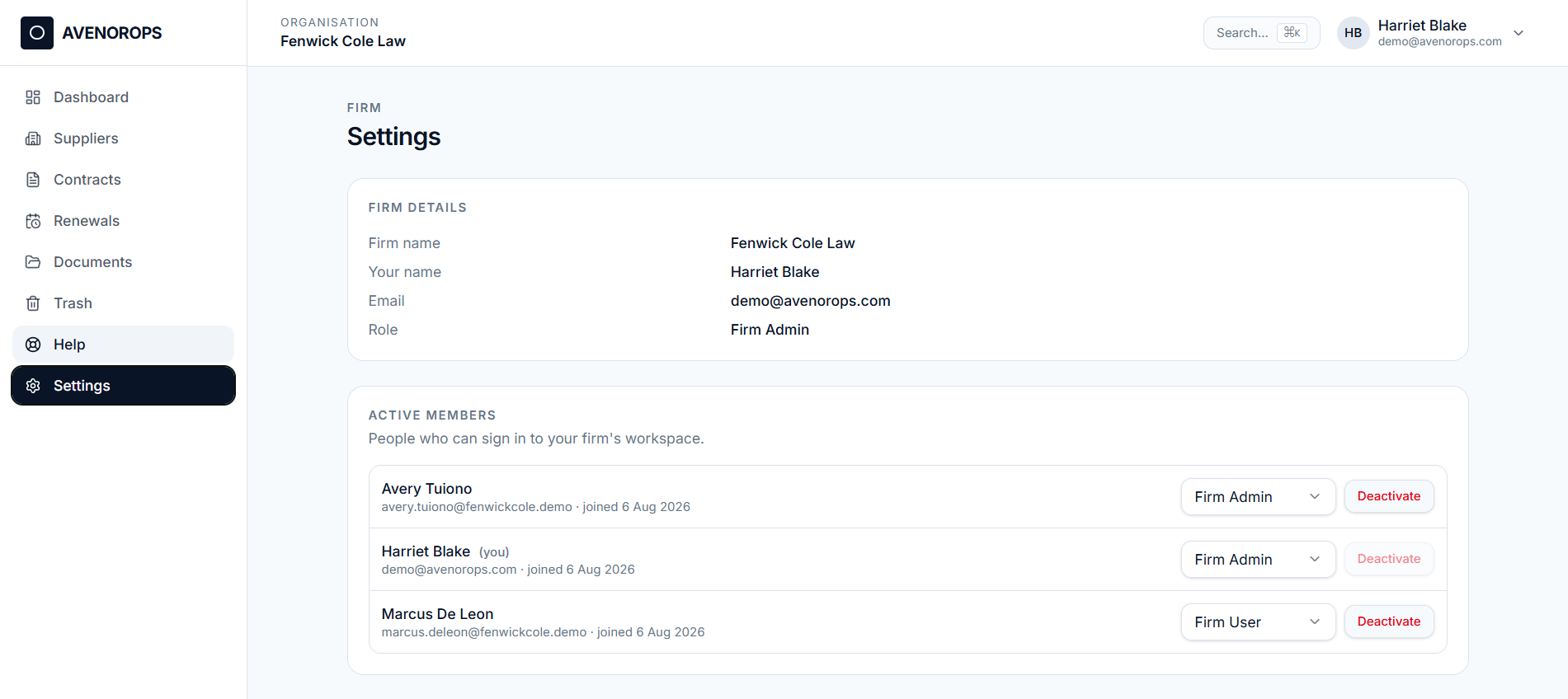
Firm administrators can see exactly who has access, change a person's role, and revoke access immediately from firm settings.
Encryption
- In transit: all traffic to the application and to the database/API is served over HTTPS/TLS.
- At rest: Supabase provides encryption at rest for the managed Postgres database and object storage as part of its platform (AWS-managed disk encryption). We rely on the platform's guarantee here; AvenorOps does not add an additional application-level encryption layer, and does not operate customer-managed encryption keys.
Sub-processors
Third parties that may process or store customer data:
- Supabase (on AWS) — database, authentication, file storage.
- Lovable — application hosting, server-side execution, and the outbound email service used to send transactional and authentication email (invitations, password resets, renewal alerts). Lovable's own downstream email-delivery provider is not something we can independently confirm; we can request written confirmation on request.
- Resend — receives emails that firm members forward into AvenorOps, including the message and any attachments, before they are passed to AvenorOps for firm-admin approval. This applies only when the firm has turned email forwarding on.
A connected AI assistant, such as Claude through the MCP connection, is not an AvenorOps sub-processor. It is a tool the firm chooses and connects under its own account and that provider's terms, and it receives AvenorOps records only when someone at the firm asks it to.
We are not aware of any other AvenorOps sub-processor that touches customer data. If you need a formal, contractually-maintained sub-processor list, tell us — it does not exist as a formal document today.
Website analytics and cookies
Website analytics — We use Google Analytics 4 on our public website to understand which pages help people and where they leave. It records page views, which buttons and forms are used, and whether a form was completed. It never receives names, email addresses or anything you type into a form, and it doesn't run inside the signed-in AvenorOps app. Google processes this data under its own privacy terms (policies.google.com/privacy). You can block these cookies through your browser settings or with Google's opt-out add-on (tools.google.com/dlpage/gaoptout).
Campaign links — Some of our links, for example in LinkedIn posts, include campaign tags (such as utm_source, utm_medium, utm_campaign and utm_content). When you first arrive on our website through such a link, we store those tags, the page you landed on and the referring website in a first-party cookie for up to 90 days. If you then request access or download a resource, we save those tags with your enquiry so we can understand which posts and channels are useful. We do not use this information for advertising or share it with third parties.
Search performance — We also use Google Search Console to see aggregate search data, such as which search terms led people to our website. This data does not identify individual visitors.
Data retention & removal
Deleted suppliers, contracts, policies, assets and documents stay recoverable in Trash for 30 days, then are permanently deleted with their stored files.
User removal is deactivation, not deletion, so ownership and audit history stays intact. On request, an individual's identifying details (name and email) can be anonymised and their login revoked — their historical records remain, attributed to a generic placeholder, so ownership and audit trails aren't broken.
Deletion of a firm's entire dataset works on a defined schedule, not an open-ended one: once AvenorOps schedules a firm for deletion (at the firm's request), a 30-day grace period applies — the schedule can be cancelled at any point before then — after which an automated job permanently deletes everything for that firm: suppliers, contracts, policies, documents (including stored files), users and their logins. A full export of the firm's data can be provided before deletion proceeds.
What isn't yet formalised: there's no committed turnaround time for how quickly AvenorOps schedules a deletion once requested, and this remains a process an AvenorOps admin carries out on the firm's behalf rather than a self-service button in the app. A fully self-service flow is planned before general availability.
Compliance & certifications
AvenorOps Limited is an early-stage New Zealand company. We do not hold SOC 2, ISO 27001, or any other third-party security certification, and we have not undergone an independent security audit or penetration test. We make no claim of alignment with any formal security framework.
We would rather tell you that plainly than imply otherwise. If your due-diligence process requires specific answers — a security questionnaire, architecture detail, or written confirmation of any point on this page — send it through and we will answer it directly and honestly.
Security contact
Security questions, vulnerability reports, or due-diligence requests: security@avenorops.com.
If you believe you have found a vulnerability, please report it to that address before disclosing it publicly, and include enough detail for us to reproduce it. We will acknowledge reports and keep you updated on the fix.
Report a security issue (our security.txt).